

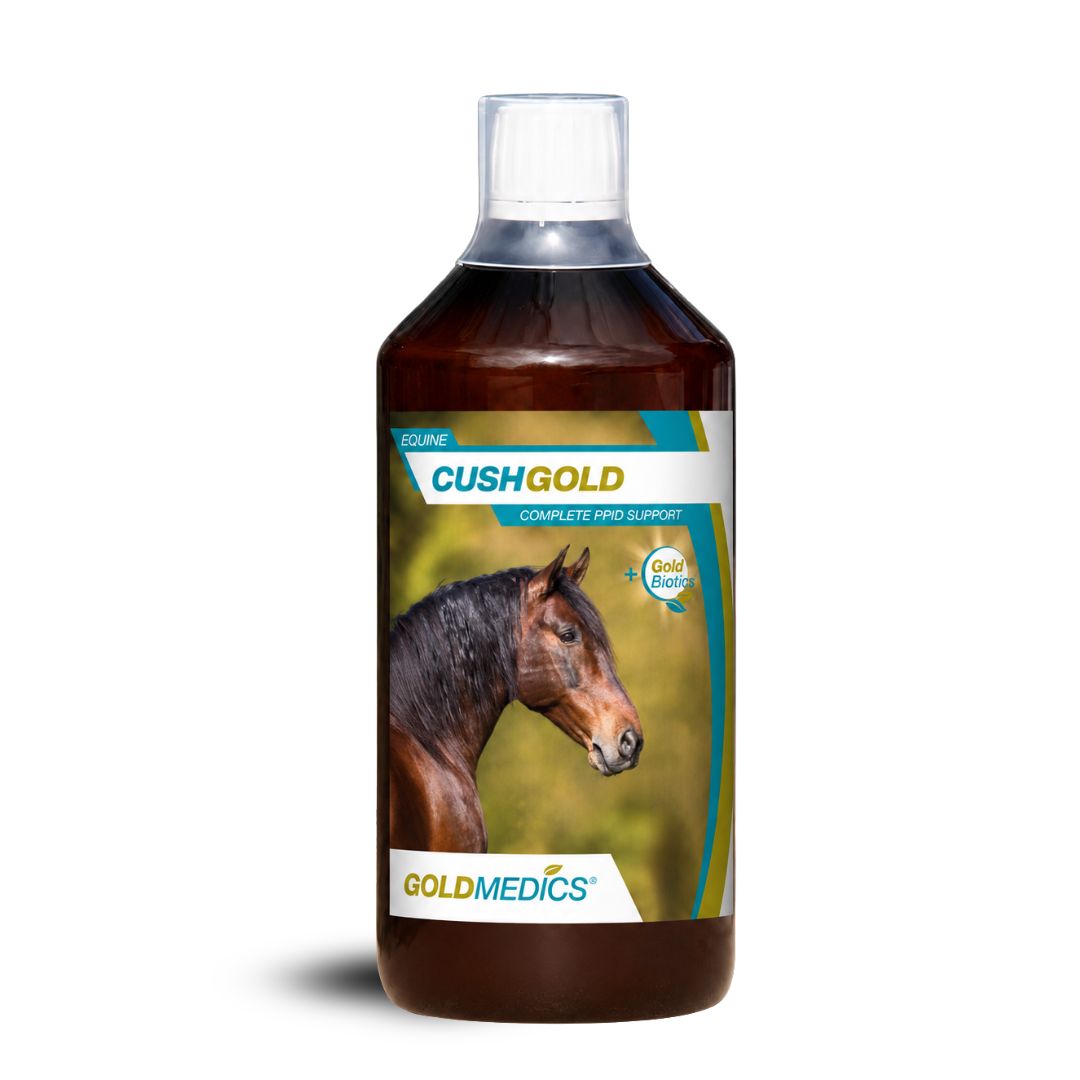
CUSHa new and more effective approach
GOLD
From € 87,95
PPID begins with a change in hormonal regulation, but its consequences are not limited to this. Glucose and insulin metabolism, general metabolism, oxidative stress and overall condition can also be affected.
CUSHGOLD therefore goes beyond hormonal support alone. The formula combines Vitex agnus-castus with GoldBiotics® ICU and carefully selected plant extracts that also support glucose and insulin metabolism.
CUSHGOLD therefore targets the entire neuroendocrine and metabolic network.
CUSHGOLD can be used as nutritional support in horses with or without pergolide treatment.
When should you choose GLUCOGOLD or CUSHGOLD?
EMS without PPID: GLUCOGOLD
PPID without EMS: CUSHGOLD
PPID combined with EMS: CUSHGOLD
When PPID occurs together with EMS, there is no need to combine CUSHGOLD and GLUCOGOLD. CUSHGOLD combines endocrine support for PPID with support for glucose and insulin metabolism.
PPID (Pituitary Pars Intermedia Dysfunction), formerly commonly referred to as Cushing’s disease, is a common hormonal disorder in horses.
The risk clearly increases with age. It is estimated that approximately 1 in 4 horses over 15 years of age has PPID.
Through oxidative stress and neurodegeneration, nerve cells in the brain die. This changes the normal dopamine control of the pituitary gland, causing the production of several hormones to become dysregulated.
Typical signs include:
- a long or curly coat that does not shed properly;
- excessive sweating;
- reduced energy and muscle mass;
- altered fat distribution;
- increased drinking and urination;
- increased susceptibility to infections;
- an increased risk of laminitis.
Many horses with PPID also develop insulin dysregulation (EMS). This combination of PPID and an increased insulin response is particularly important in relation to the risk of laminitis.
PPID is therefore much more than a coat or hormonal problem. It affects the whole horse.
Many existing PPID supplements are mainly based on Vitex agnus-castus (chaste tree). Other products combine Vitex with ingredients such as Mucuna, Ginkgo and cinnamon.
Often, for cost reasons, herbs are used as such without sufficient attention to whether adequate amounts of the active compounds are actually present. CUSHGOLD contains only highly concentrated extracts with guaranteed levels of active compounds.
CUSHGOLD also deliberately takes a broader approach.
Vitex supports endocrine balance, while CUSHGOLD combines it with ingredients that also target:
hormonal balance → glucose & insulin → gut microbiome → oxidative stress → complete metabolic network
This is important because PPID and insulin dysregulation frequently occur together.
CUSHGOLD also contains GoldBiotics® ICU, supporting the gut microbiome and allowing it to exert its essential influence.
Not one ingredient. Not one mechanism of action. Integrated support for the neuroendocrine and metabolic network.
When should you choose GLUCOGOLD or CUSHGOLD?
EMS without PPID: GLUCOGOLD
PPID without EMS: CUSHGOLD
PPID combined with EMS: CUSHGOLD
When PPID occurs together with EMS, there is no need to combine CUSHGOLD and GLUCOGOLD. CUSHGOLD combines endocrine support for PPID with support for glucose and insulin metabolism.
Support with GLUCOGOLD or GLUCOGOLD should be considered as part of the horse’s overall management. In horses with PPID as well as horses with EMS, a higher dose of natural Vitamin E remains important, alongside a diet low in starch and sugar and the other recommended management measures.
Vitex agnus-castus – endocrine support
Vitex or chaste tree is the best-known plant ingredient for nutritional support in horses with PPID.
Published studies and practical experience indicate beneficial effects on several visible signs. Improvements have been described in shedding and coat quality, vitality, behaviour, excessive drinking and urination and signs associated with laminitis.
Vitex alone, however, does not reliably reduce ACTH.
CUSH GOLD therefore deliberately goes beyond Vitex alone.
GoldBiotics® ICU – support from the gut
The gut microbiota does much more than digest food. Gut bacteria produce short-chain fatty acids (SCFAs), important compounds for the intestinal wall and communication between the gut and metabolism.
GoldBiotics® ICU combines pre- and postbiotic support of the gut microbiome. In an internal study in healthy horses, an exceptional 60% increase in SCFA production was observed with GoldBiotics® ICU.
Morus alba – glucose and insulin support
Morus alba (white mulberry) contains DNJ, a natural substance that inhibits certain enzymes involved in breaking down carbohydrates in the intestine.
This allows absorbable sugars to become available more gradually and may limit the insulin response after feeding.
Importantly, this has now been investigated directly in horses, including horses with a disrupted insulin response.
Gymnema sylvestre – reduced rapid glucose uptake
Gymnema contains natural gymnemic acids that can influence glucose uptake from the intestine.
Gymnema has also been studied in ponies, where a reduction in the postprandial glucose and insulin response was observed.
Gymnema and Morus therefore work through different but complementary mechanisms.
Momordica charantia – support for glucose utilisation
Momordica, or bitter melon, contains several bioactive compounds extensively studied for their influence on glucose utilisation and insulin signalling.
Comparable intervention studies in horses are not yet available, but there is a substantial amount of convincing human clinical research on glucose metabolism.
Trigonella foenum-graecum – support for the insulin response
Fenugreek contains, among other compounds, 4-hydroxy-isoleucine (4-HIL).
This bioactive compound is of interest because of its role in glucose and insulin metabolism. A significant part of the scientific evidence also comes from human clinical studies.
Cinnamomum / cinnamon – additional metabolic support
Cinnamon contains natural polyphenols studied for their influence on glucose metabolism and insulin sensitivity.
Astaxanthin – protection against oxidative stress
Astaxanthin from Haematococcus pluvialis is a powerful natural antioxidant that helps protect cells and cell membranes against oxidative stress.
This is relevant in ageing horses because oxidative stress is closely associated with ageing and metabolic dysregulation.
Astaxanthin has also been studied in horses, where improvements in antioxidant status and reductions in markers of oxidative damage were observed.
CUSHGOLD is available in 1 L and 5 L.
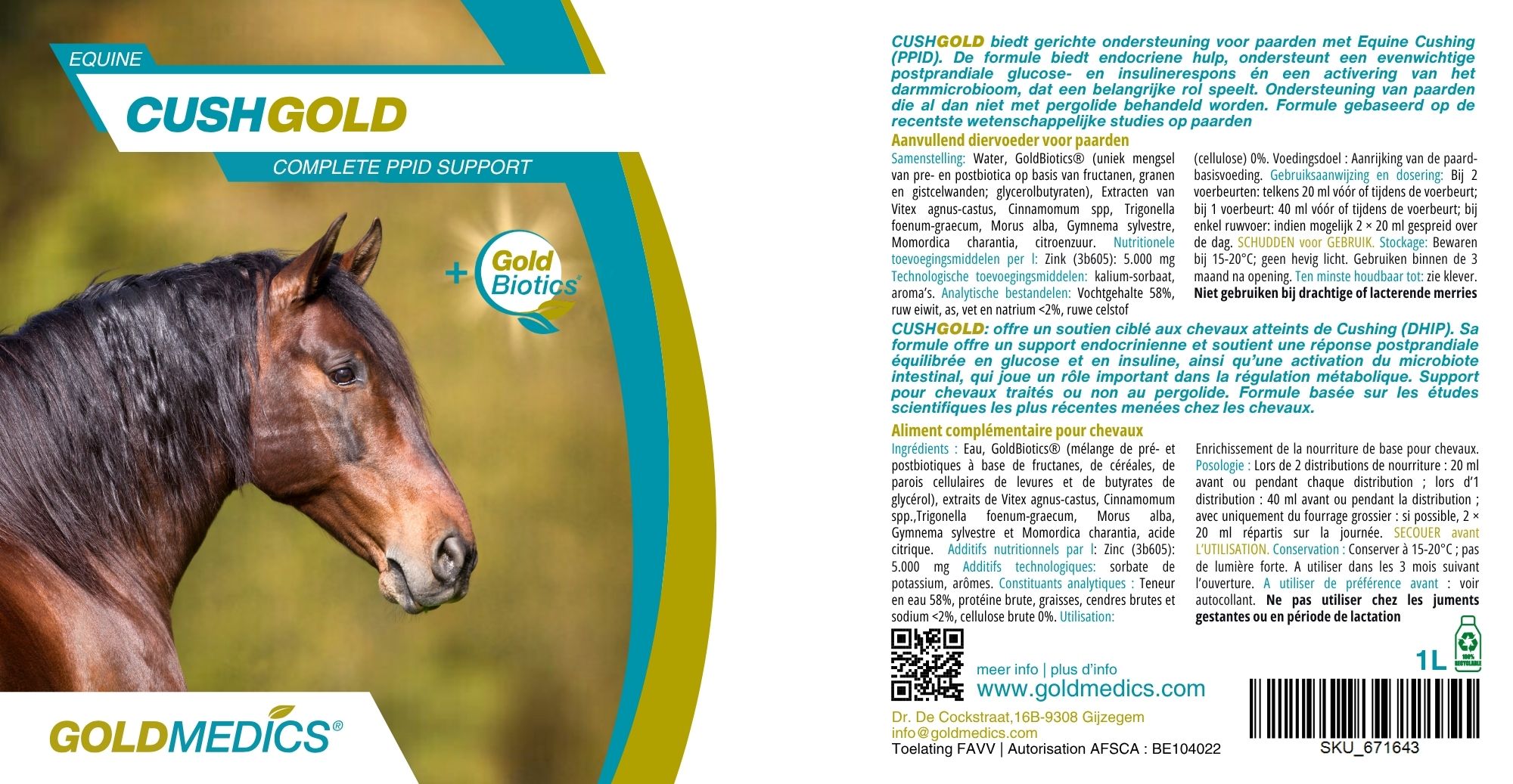
Directions and dosage: With 2 feedings: 20 ml before or during each feeding; with 1 feeding: 40 ml before or during the feeding; with forage only: if possible, 2 × 20 ml spread throughout the day.
Do not use in pregnant or lactating mares.
Description
- GOLDMEDICS consists of a team of four veterinarians and two doctors in sciences who design, develop, test, produce, and market their own products. This is always done on the basis of the latest scientific insights and years of clinical experience.
- Our supplements are used and recommended daily by veterinarians and clinics, and are the first choice of equine- and petspecialists.
- Exclusively available through your veterinarian or via our official webshop.
- “Health starts in the gut” ~ GOLDMEDICS, 2015. Most GOLDMEDICS supplements contain the unique GoldBiotics® formula, which has a proven, wide-ranging impact on the whole body through the gut microbiome.
- “There is always a better way” ~ Thomas Edison (1880; 1,400 patents). We share this philosophy, which is why we continuously improve our formulations.
- The results speak for themselves, read more about them on our blog page.
In need of personal support or information?
Call us: +32 495 59 65 31 of +32 475 490 760
Or e-mail us (we respond 7/7 within 12 hours)