

At GOLDMEDICS, we believe that even the best formula can always continue to evolve. “There is always a better way.” — Thomas Edison. That is why we continuously evaluate and improve our products whenever new scientific insights give us reason to do so.
The latest update? We are adding natural astaxanthin to the new production batches of VITA E GOLD and VITA E PLATINUM and COMBI PLATINUM. Vitamin E and astaxanthin are both antioxidants, but they do not work in exactly the same way. That is precisely why they complement each other so well.
Why are VITA E GOLD, VITA E PLATINUM and COMBI PLATINUM now even more unique?
1. Unlike many feeds, balancers and supplements, we use no synthetic vitamin E, but 100% natural vitamin E!
2. Not only the alpha form, but the entire vitamin E family in the natural ratio in which they occur in grass.
3. And now an even broader antioxidant network through synergy with astaxanthin.

Why are antioxidants important for your horse?
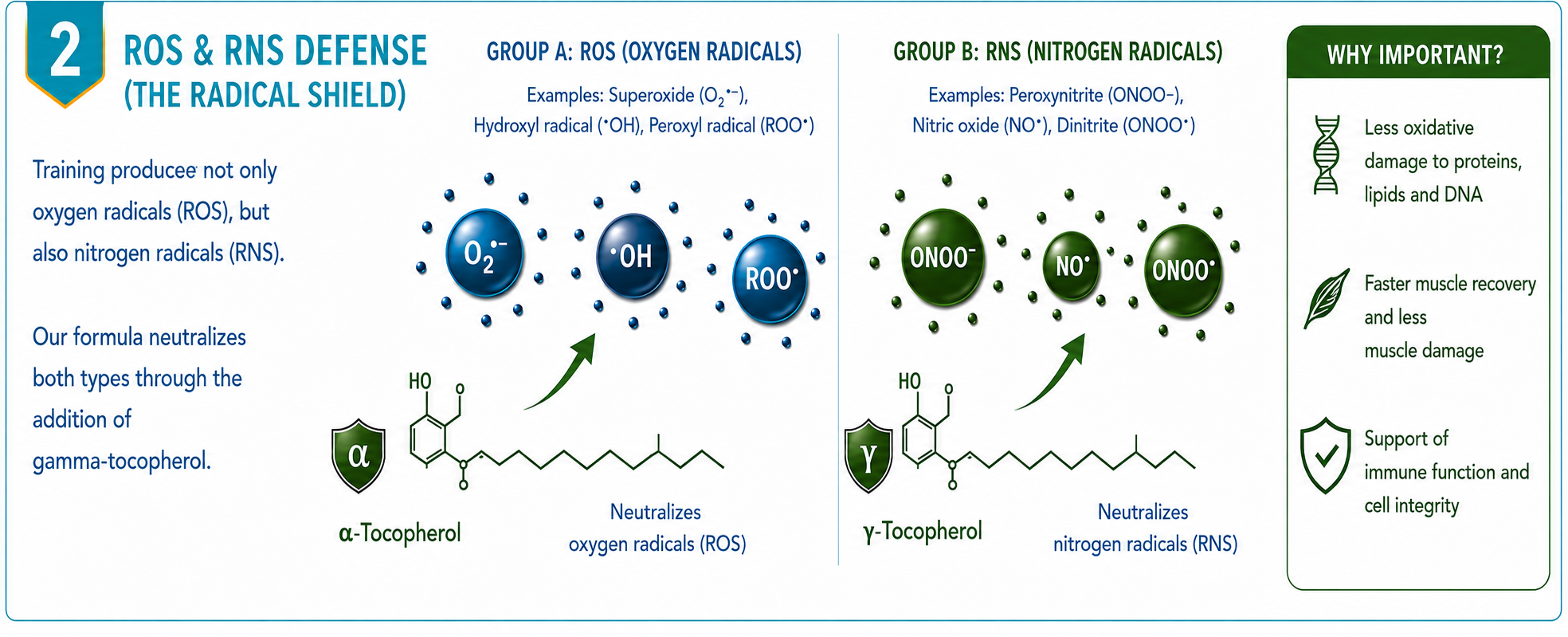
Free radicals are produced during many normal processes in the body. During exercise, energy production in the muscle cells increases and reactive oxygen species (free radicals) are formed. The body can neutralise these thanks to its own antioxidant defence. The vitamin E family and astaxanthin are special antioxidants.
In horses that are not working, both young and old, a basic antioxidant level is essential. The greater the workload, the more antioxidant neutralisation is required to help prevent oxidative stress. For sport horses and horses undergoing intensive training, recovery or periods of increased need, a higher antioxidant supply is therefore very important. Research in intensively trained horses shows that higher levels of exercise affect oxidative status and that nutritional antioxidants such as vitamin E play a role in this. [1]
VITA E GOLD and VITA E PLATINUM are based on 100% natural vitamin E rather than synthetic vitamin E (which contains only 15% natural vitamin E). By adding natural astaxanthin, we now bring together two natural antioxidant sources that complement each other at different levels and are optimally absorbable.
1. Why vitamin E and astaxanthin work so well together
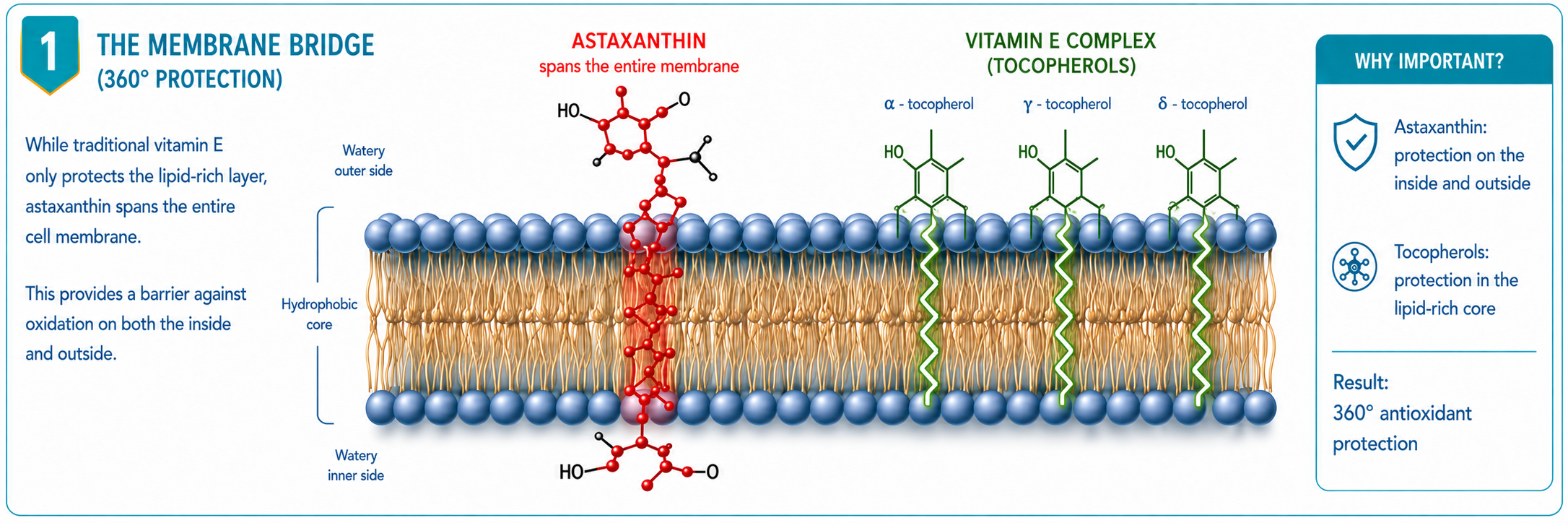
Vitamin E is fat-soluble and is mainly located in the lipid-rich parts of the cell membrane. There, it helps protect the cell against oxidative damage. Astaxanthin has a different molecular structure: research on cell membranes shows that astaxanthin can position itself across the membrane. [2]
Put simply: Vitamin E mainly protects the lipid-rich parts of the cell membrane. Astaxanthin provides complementary protection across the membrane.
They therefore do not simply do the same thing. Precisely because they are active in different ways, they can complement each other. This is the main reason why we are adding astaxanthin to the renewed VITA E GOLD and VITA E PLATINUM formulas.
2. Vitamin E is more than alpha-tocopherol alone
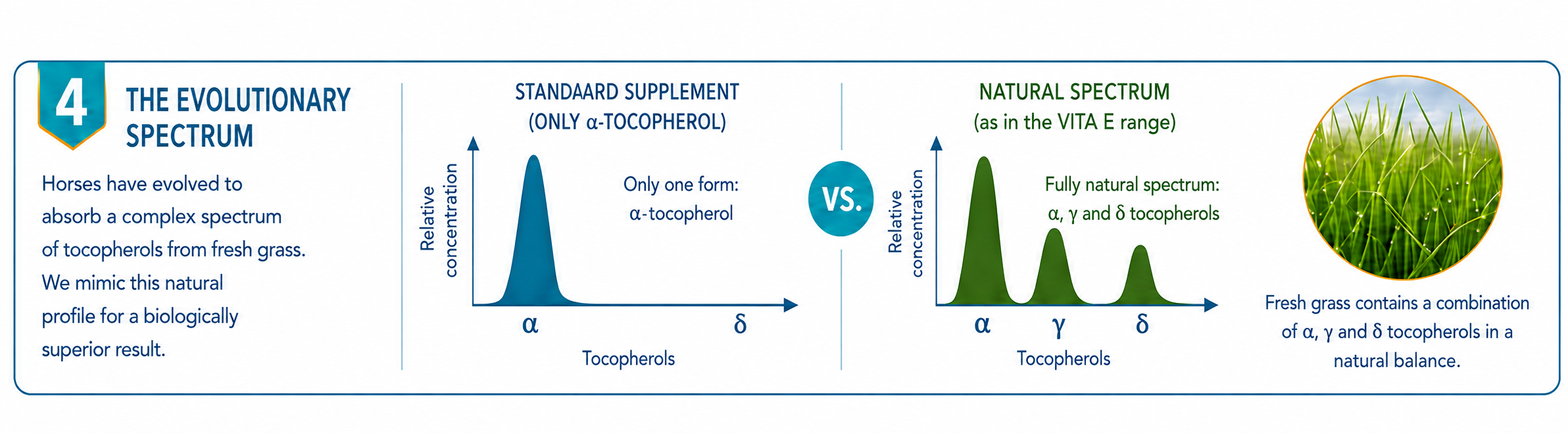
When we talk about vitamin E, we usually think of α-tocopherol. But in nature, vitamin E consists of a family of different tocopherol compounds. In natural feed, beta-, gamma- and delta-tocopherol occur alongside α-tocopherol.
For horses, fresh spring grass is an important natural source of vitamin E. In other seasons, levels are lower to considerably lower. Horses with access to fresh grass generally have a better natural vitamin E status than horses mainly fed stored forage, in which up to 80% of vitamin E is lost during storage. [3]
The different tocopherols share some properties, but also have distinct characteristics. α-Tocopherol is best known for its role in protecting against lipid oxidation. Gamma-tocopherol is also very important for horses because it also neutralises reactive nitrogen species.
This is why VITA E GOLD and VITA E PLATINUM do not focus exclusively on one isolated form of vitamin E, but on the natural spectrum of tocopherols and in the same ratio as found in grass.
By combining this vitamin E complex with astaxanthin, we bring together different antioxidant mechanisms in one formula.
3. What do we already know about astaxanthin in horses?
Astaxanthin has now also been studied specifically in horses. In 2024, a study was published involving Arabian racehorses that underwent four months of intensive training. Horses receiving astaxanthin showed changes in several markers of antioxidant status and oxidative load.
The researchers concluded that astaxanthin helped counteract training-related oxidative stress and helped preserve the horse’s natural antioxidant defence. [4]
GoldMedics uses natural astaxanthin produced by Haematococcus fluvialis, an alga that naturally occurs in many surface waters. In animals that consume much larger amounts of it, such as salmon and flamingos, the red colour can even become visible in the skin.
4. What about energy production in the muscle?
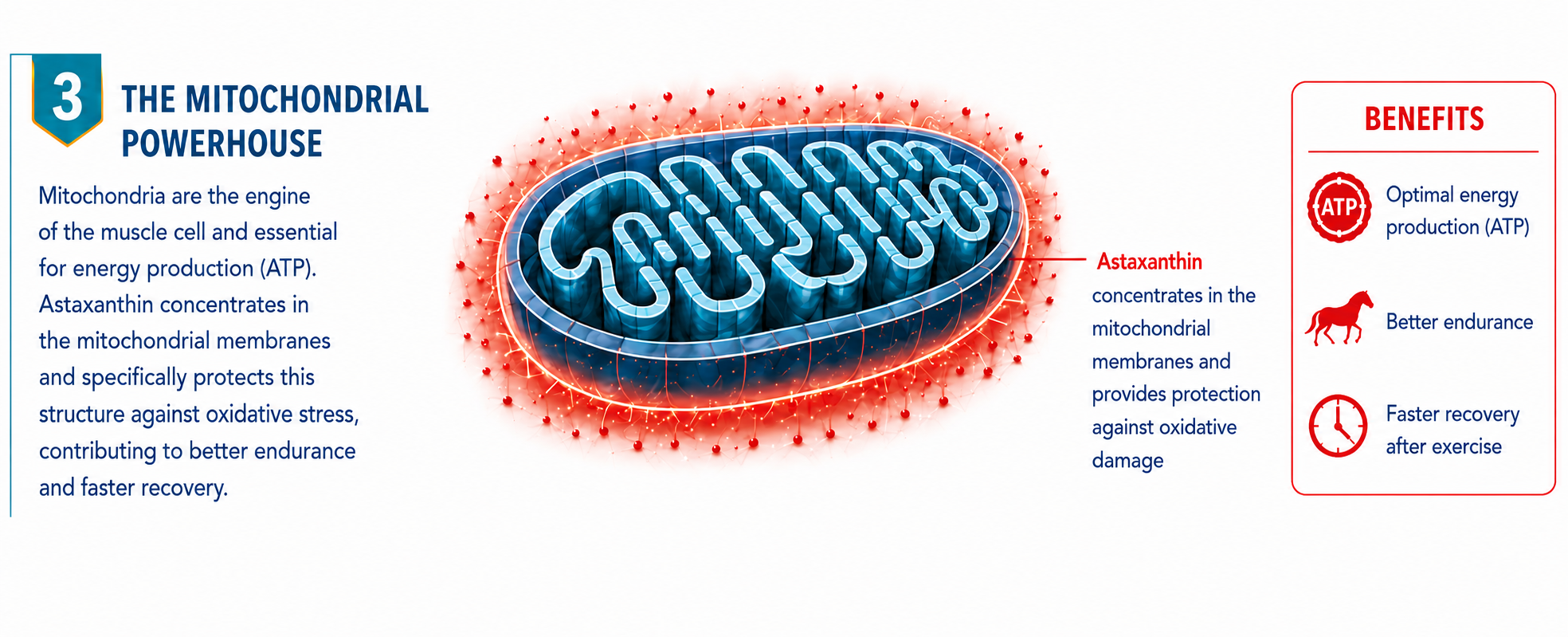
Muscle cells need a great deal of energy during exercise. Much of this energy is produced in the mitochondria, often referred to as the powerhouses of the cell. The harder the muscles work, the more active these processes become.
A follow-up study in Arabian racehorses from 2025 found changes in several processes involved in mitochondrial function and maintenance following astaxanthin supplementation. [5]
For us, this is another reason to view astaxanthin not as a replacement for vitamin E, but as a complement to the existing antioxidant network.
Which GOLDMEDICS products are getting astaxanthin?
Natural astaxanthin is being added to the new production batches of VITA E GOLD and VITA E PLATINUM and COMBI PLATINUM.
In VITA E GOLD, astaxanthin is added as a complementary antioxidant within the trusted natural vitamin E formula.
VITA E PLATINUM also receives natural astaxanthin (+50%), while the existing Intensive Care formula containing, among others, vitamin C ester, grape polyphenols and tocotrienols remains unchanged.
COMBI PLATINUM also receives astaxanthin as an additional antioxidant within its broad all-round formula.
When will you receive the new VITA E formula?
We are introducing the update gradually. First, we will use up our existing stock of VITA E GOLD and VITA E PLATINUM and COMBI PLATINUM.
Once the existing stock of each product has been used, we will switch to the new production batches containing natural astaxanthin.
During the transition period, the current and renewed formulas may therefore temporarily be available at the same time. You can recognise the updated VITA E GOLD and VITA E PLATINUM and COMBI PLATINUM by the wording “update + astaxanthin” on the label.
Why does the new formula look more red?
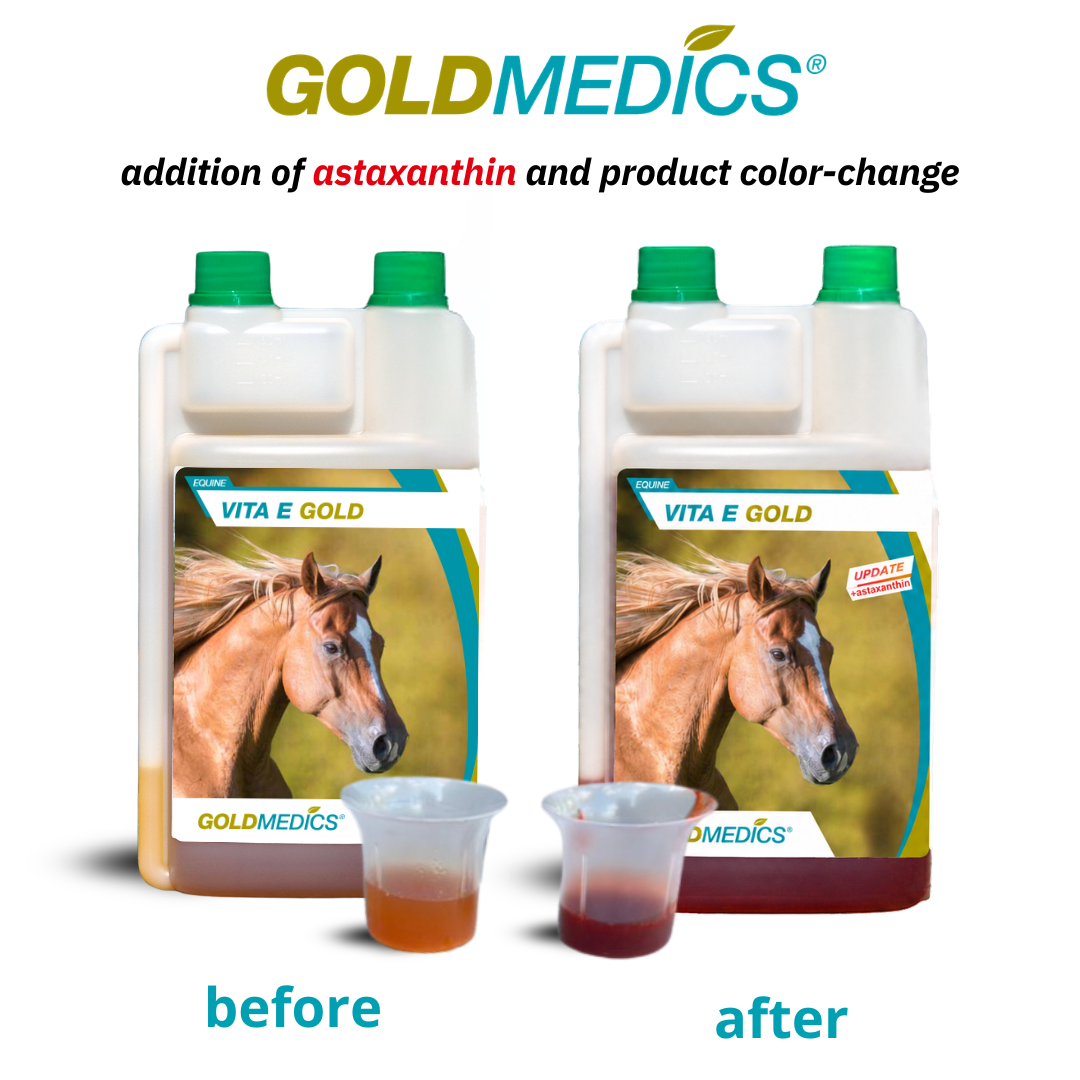
This is probably the difference you will notice most quickly as a horse owner. Astaxanthin naturally has a distinctive reddish colour. As a result, the renewed VITA E formula is visibly redder than before.
This colour difference is completely normal and has no negative effect on the quality or palatability of VITA E GOLD and VITA E PLATINUM or COMBI PLATINUM. It is simply the visible result of adding natural astaxanthin.
The same trusted VITA E formulas, further developed
With this update, VITA E GOLD and VITA E PLATINUM and COMBI PLATINUM combine the natural vitamin E complex with natural astaxanthin.
This brings together antioxidants that can complement each other at different levels. For horses with increased needs — particularly horses in training, competition or recovery — this means broader antioxidant support for muscles and cells.
VITA E GOLD and VITA E PLATINUM and COMBI PLATINUM: the same trusted GOLDMEDICS quality, further developed based on new scientific insights.
Scientific references
[1] Rey, A.I., Segura, J., Arandilla, E. & López-Bote, C.J. (2013). Short- and long-term effect of oral administration of micellized natural vitamin E (D-α-tocopherol) on oxidative status in race horses under intense training. Journal of Animal Science, 91(3), 1277–1284.
[2] Shibata, A., Kiba, Y., Akati, N. & Fukuzawa, K. (2001). Molecular characteristics of astaxanthin and β-carotene in the phospholipid monolayer and their distributions in the phospholipid bilayer. Chemistry and Physics of Lipids, 113(1–2), 11–22.
[3] Finno, C.J. et al. (2020). Influence of specific management practices on blood selenium, vitamin E, and beta-carotene concentrations in horses and risk of nutritional deficiency. Journal of Veterinary Internal Medicine, 34(5), 2132–2142.
[4] Giercuszkiewicz-Hecold, B. et al. (2024). The effect of long term astaxanthin supplementation on the antioxidant status of racing Arabian horses – preliminary study. Scientific Reports, 14, 27991. DOI: 10.1038/s41598-024-77732-9.
[5] Giercuszkiewicz-Hecold, B., Pajuelo, D., Steczkiewicz, Z., et al. (2025). Astaxanthin supplementation in Arabian racing horses mitigates oxidative stress and inflammation in peripheral blood mononuclear cells through enhanced mitophagy. Scientific Reports, 15, 14633. DOI: 10.1038/s41598-025-93661-7.
Meta description:
Discover why VITA E GOLD and VITA E PLATINUM now combine natural astaxanthin with 100% natural vitamin E for broader antioxidant support in horses.